
Behind every tablet, capsule, and powder sachet lies an invisible world of microscopic particles. Their size, shape, and surface characteristics determine how a drug dissolves, flows, mixes, and compresses. Even slight changes at the particle level can affect stability, bioavailability, and manufacturing efficiency.
This science is known as micromeretics—the study of small particles and powders. UNIT 4 reveals how controlling particle properties ensures that medicines are safe, effective, and consistent from batch to batch.
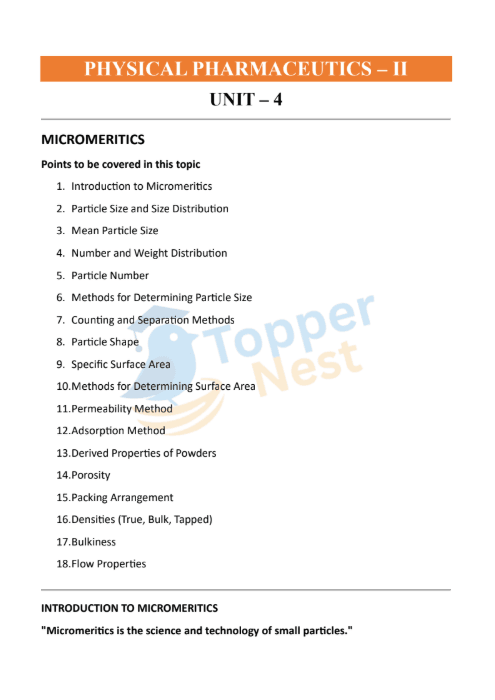
What Is Micromeretics?
Micromeretics deals with the measurement and characterization of particles, especially powders used in pharmaceutical formulations.
It helps scientists understand:
- Drug dissolution rate
- Flowability of powders
- Uniform mixing
- Tablet compression behavior
Without micromeretic control, manufacturing becomes unpredictable.
Particle Size and Distribution
Why Particle Size Matters
Particle size directly influences:
- Solubility
- Absorption
- Stability
- Content uniformity
Smaller particles provide larger surface area and dissolve faster.
Mean Particle Size
Mean particle size represents the average size of particles in a sample.
Common Means
- Arithmetic mean
- Surface mean
- Volume mean
- Weight mean
Each mean is selected based on the intended application.
Number and Weight Distribution
Number Distribution
Counts the number of particles in each size range.
Useful for fine powders.
Weight Distribution
Based on mass of particles.
More relevant for bulk pharmaceutical powders.
Understanding both distributions gives a complete picture of sample characteristics.
Particle Number and Counting Methods
Accurate counting helps determine uniformity.
Counting and Separation Methods
Common Techniques
- Microscopy
- Coulter counter
- Sedimentation
- Sieving
These methods separate particles based on size or count them directly.
Microscopy allows visual observation of size and shape, while sieving is preferred for coarse powders.
Methods for Determining Particle Size
Different methods are used depending on particle range.
Techniques Include
- Optical microscopy
- Electron microscopy
- Sieving
- Sedimentation analysis
- Laser diffraction
Each technique offers advantages for specific size ranges.
Particle Shape
Particle shape affects flow and packing.
Common Shapes
- Spherical
- Cubical
- Rod-shaped
- Irregular
Spherical particles flow better and compress uniformly, which is ideal for tablet manufacturing.
Specific Surface Area
What Is Surface Area?
Surface area is the total exposed area of particles.
Greater surface area leads to:
- Faster dissolution
- Better adsorption
- Increased reactivity
Methods for Determining Surface Area
Common Techniques
- Gas adsorption (BET method)
- Air permeability
- Mercury porosimetry
These methods help evaluate drug dissolution behavior.
Permeability and Adsorption
Permeability
Indicates how easily air or liquid passes through powder beds.
Used to estimate surface area and porosity.
Adsorption
Particles adsorb gases or liquids on their surfaces.
Important in drug stabilization and formulation.
Derived Properties of Powders
Derived properties describe bulk powder behavior.
Porosity
Porosity refers to empty spaces between particles.
High porosity:
- Enhances dissolution
- Reduces density
Low porosity:
- Increases compactness
Packing Arrangement
Particles arrange themselves in:
- Loose packing
- Closest packing
Packing influences flow and compression.
Densities
Different density terms describe powder behavior.
Types
- True density
- Bulk density
- Tapped density
Bulk and tapped densities help determine compressibility and flow.
Bulkiness
Bulkiness is the reciprocal of bulk density.
It indicates the volume occupied by a given mass.
Important in capsule filling and packaging.
Flow Properties
Good flow is essential for uniform tablet weight.
Factors Affecting Flow
- Particle size
- Shape
- Moisture
- Surface roughness
Flow Tests
- Angle of repose
- Carr’s index
- Hausner ratio
Better flow ensures consistent manufacturing.
Why Micromeretics Matters in Pharmacy
Micromeretics plays a critical role in:
- Tablet formulation
- Capsule filling
- Suspension stability
- Powder mixing
- Drug dissolution control
Without understanding these properties, dosage uniformity cannot be guaranteed.