
Every medicine carries an expiry date—but that date is not random. It is carefully calculated using drug stability studies and reaction kinetics. If a drug degrades too quickly, it loses potency and may even become unsafe. Therefore, understanding how drugs break down and how to prevent degradation is a core part of pharmaceutical science.
UNIT 5 focuses on chemical degradation, kinetics, stabilization methods, and accelerated testing, helping students understand how shelf life is scientifically determined.
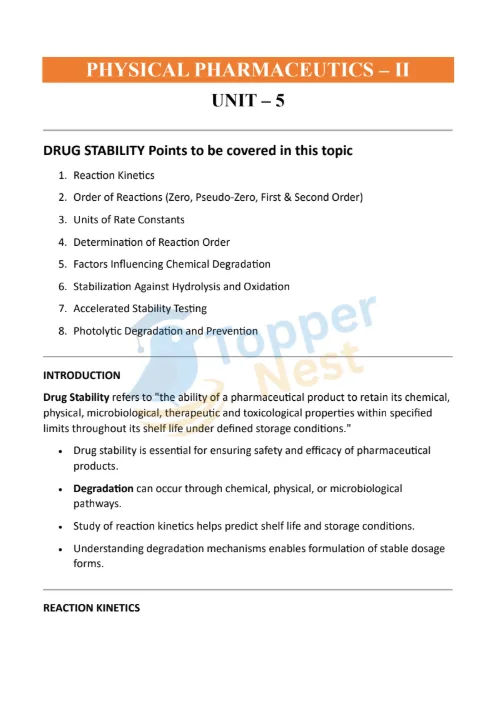
Reaction Kinetics in Drug Stability
What Is Reaction Kinetics?
Reaction kinetics studies the rate at which drugs degrade over time. By analyzing degradation speed, scientists can predict shelf life.
The rate of degradation is expressed as:
Rate = change in concentration per unit time
Zero-Order Reactions
Definition
Drug degradation occurs at a constant rate independent of concentration.
Characteristics
- Linear decrease with time
- Rate constant units: concentration/time
Examples
Suspensions and controlled-release systems often show zero-order kinetics.
Pseudo-Zero Order Reactions
When one reactant is present in excess, the reaction behaves like zero order even though it is not truly zero order.
Common in pharmaceutical suspensions where water is in large excess.
First-Order Reactions
Definition
Rate depends on drug concentration.
Characteristics
- Log concentration vs time is linear
- Units: time⁻¹
Most pharmaceutical degradations follow first-order kinetics.
Half-Life Formula
t½ = 0.693/k
Second-Order Reactions
Definition
Rate depends on concentrations of two reactants.
Units
(concentration⁻¹ × time⁻¹)
Less common but observed in bimolecular reactions.
Determination of Reaction Order
Scientists determine reaction order by:
- Plotting concentration vs time
- Log concentration vs time
- Reciprocal concentration vs time
The straight-line plot indicates the reaction order.
Factors Influencing Chemical Degradation
Drug stability is affected by several physical and chemical parameters.
Temperature
Higher temperature increases degradation rate.
According to Arrhenius equation, even a 10°C rise may double the reaction rate.
Proper storage conditions are essential.
Solvent Effects
Solvents influence drug stability through polarity and solubility.
Aqueous solutions often degrade faster than solid forms.
Ionic Strength
Increased ionic concentration may accelerate reactions by altering electrostatic interactions.
Buffer systems must be carefully designed.
Dielectric Constant
Solvent polarity affects ionization and reaction speed.
Highly polar solvents may enhance degradation.
Acid–Base Catalysis
Specific Catalysis
Only hydrogen or hydroxyl ions participate.
General Catalysis
Other acids or bases also contribute.
pH adjustment is crucial to maintain stability.
Simple Numerical Problems (Conceptual Examples)
Example 1: First Order
If k = 0.01 day⁻¹
t½ = 0.693 / 0.01 = 69.3 days
Example 2: Zero Order
If 5 mg degrades per day
After 10 days → 50 mg lost
Such calculations help estimate shelf life.
Stabilization of Medicinal Agents
Drugs are protected against common degradation pathways.
Hydrolysis Prevention
- Use dry formulations
- Control pH
- Add stabilizers
- Store in moisture-proof containers
Oxidation Prevention
- Add antioxidants
- Use nitrogen flushing
- Avoid air exposure
- Use amber containers
These strategies improve product longevity.
Accelerated Stability Testing
What Is Accelerated Testing?
Products are stored at high temperature and humidity to speed degradation.
Typical conditions:
- 40°C
- 75% RH
Data is extrapolated to predict real-time stability.
Benefits
- Quick shelf-life estimation
- Regulatory approval
- Cost savings
Expiration Dating
Expiration date is the time when drug retains at least 90% potency.
It is calculated using kinetic data and stability studies.
This ensures safety and efficacy for patients.
Photolytic Degradation
Light-Induced Breakdown
Some drugs degrade when exposed to light, especially UV radiation.
Prevention Methods
- Amber glass bottles
- Aluminum foil packaging
- Light-resistant coatings
- Proper storage
Protection from light preserves drug quality.
Why Drug Stability Matters in Pharmacy
Drug stability ensures:
- Correct dosage
- Patient safety
- Therapeutic effectiveness
- Regulatory compliance
Unstable drugs may lead to treatment failure or toxicity.