
Long before synthetic laboratories existed, healing came directly from nature—leaves, roots, resins, and animal products formed the earliest medicines. Even today, nearly half of modern drugs trace their origin to natural sources. The science that studies these crude drugs is pharmacognosy, a bridge between traditional remedies and modern pharmaceutical research.
UNIT 1 introduces the foundations of pharmacognosy, focusing on drug sources, classification, and quality control methods that ensure safety, purity, and effectiveness of natural medicines.
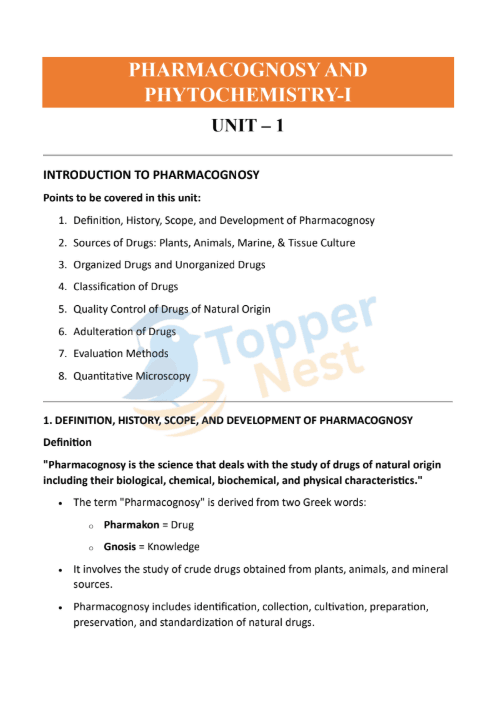
Definition, History, Scope, and Development of Pharmacognosy
What Is Pharmacognosy?
Pharmacognosy is the study of drugs obtained from natural sources such as plants, animals, marine organisms, and microorganisms. It involves identification, evaluation, and quality control of crude drugs.
Historical Background
Ancient systems like Ayurveda, Chinese medicine, and Egyptian herbal practices relied heavily on plant-based remedies. Over time, isolation of active principles like alkaloids and glycosides led to scientific validation of natural medicines.
Today, pharmacognosy supports:
- Herbal drug standardization
- Discovery of new bioactive compounds
- Development of phytopharmaceuticals
- Conservation of medicinal plants
Sources of Drugs
Natural drugs originate from diverse biological systems.
Plant Sources
Leaves, roots, bark, seeds, and flowers provide many important medicines such as digitalis and senna.
Animal Sources
Hormones, enzymes, and fats are derived from animals. Examples include insulin and cod liver oil.
Marine Sources
Marine organisms yield antibiotics, anticancer agents, and unique bioactive molecules.
Tissue Culture
Plant tissue culture allows controlled production of valuable secondary metabolites without overharvesting natural plants.
These varied sources ensure continuous discovery of therapeutic compounds.
Organized and Unorganized Drugs
Crude drugs are categorized based on structure.
Organized Drugs
These retain cellular structure and include:
- Leaves
- Roots
- Seeds
- Bark
They can be studied microscopically.
Unorganized Drugs
These lack cellular structure and are obtained as secretions or extracts.
Examples
- Dried latex
- Dried juices
- Extracts
- Gums and mucilages
- Oleoresins
- Oleo-gum-resins
These are commonly used in syrups, ointments, and formulations.
Classification of Drugs
Proper classification helps easy identification and study.
Methods of Classification
Alphabetical
Arranged by name for convenience.
Morphological
Based on plant part used.
Taxonomical
Based on botanical family.
Chemical
Based on active constituents.
Pharmacological
Based on therapeutic action.
Chemotaxonomical
Based on chemical markers.
Serotaxonomical
Based on antigen–antibody reactions.
Each method offers specific advantages in research and quality control.
Quality Control of Drugs of Natural Origin
Ensuring authenticity and purity is crucial for patient safety.
Adulteration of Natural Drugs
Adulteration refers to substitution or mixing of inferior or harmful materials.
Causes
- Economic gain
- Scarcity
- Misidentification
- Poor storage
Adulteration reduces efficacy and may cause toxicity.
Evaluation Methods
Quality control involves several evaluation techniques.
Organoleptic Evaluation
Uses sensory organs.
Includes
- Color
- Odor
- Taste
- Texture
Simple but useful for preliminary identification.
Microscopic Evaluation
Helps detect structural features like fibers, vessels, and starch grains. Essential for powdered drugs.
Physical Evaluation
Determines measurable parameters such as:
- Moisture content
- Ash value
- Extractive value
- Melting point
These indicate purity and stability.
Chemical Evaluation
Involves identification of active constituents using chemical tests and chromatographic techniques.
Biological Evaluation
Assesses pharmacological activity through bioassays.
Ensures therapeutic effectiveness.
Quantitative Microscopy of Crude Drugs
Quantitative parameters help standardize herbal drugs.
Important Techniques
Lycopodium Spore Method
Counts spores to estimate particle number.
Leaf Constants
Includes stomatal number, stomatal index, and vein islet number.
Camera Lucida
Projects microscopic images for accurate drawings and measurements.
These techniques ensure precise identification and prevent substitution.
Why Pharmacognosy Matters Today
Pharmacognosy remains vital because it:
- Promotes safe herbal medicines
- Supports drug discovery
- Prevents adulteration
- Ensures quality control
With increasing global interest in herbal therapy, this field is more relevant than ever.