
In hospitals, research laboratories, and pharmaceutical factories, an invisible battle is constantly underway. Fungi, viruses, and bacteria threaten product safety and human health, while disinfectants and sterility testing work as powerful defenses. UNIT 3 explores this crucial intersection of microbial biology and infection control, helping students understand how microorganisms grow and how science keeps them in check.
From antifungal drugs to sterile injections, microbiological control ensures medicines are both effective and safe.
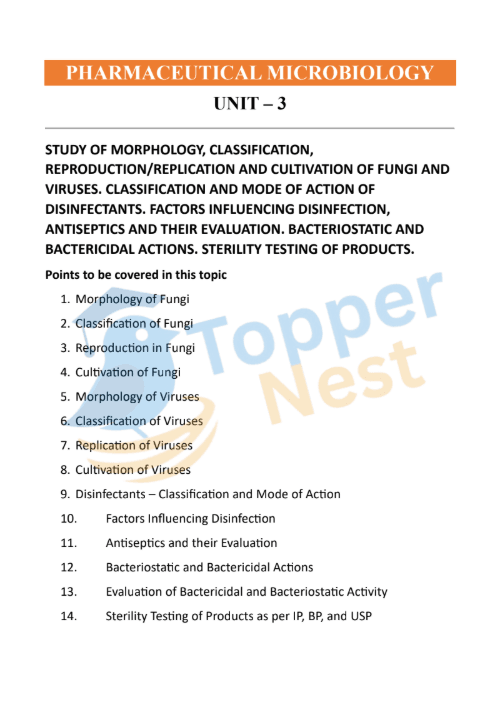
Fungi: Morphology, Classification, and Growth
Morphology of Fungi
Fungi are eukaryotic microorganisms with a defined nucleus and complex cellular structure. Their bodies typically consist of:
- Cell wall made of chitin
- Filamentous hyphae
- Mycelium network
- Spores for reproduction
These structural features make fungi more complex than bacteria.
Classification of Fungi
Fungi are grouped into:
- Yeasts (unicellular, oval-shaped)
- Molds (multicellular, filamentous)
- Dimorphic fungi (exist in both forms)
Each type has medical and industrial importance, ranging from infections to antibiotic production.
Reproduction and Cultivation
Fungi reproduce through budding, fragmentation, or spore formation. They are cultivated on media like Sabouraud dextrose agar under slightly acidic conditions.
Proper temperature, moisture, and oxygen supply are essential for successful growth in laboratories.
Viruses: Structure, Classification, and Replication
Morphology of Viruses
Viruses are acellular particles composed of:
- Genetic material (DNA or RNA)
- Protein capsid
- Sometimes a lipid envelope
They lack independent metabolism and depend entirely on host cells.
Classification
Viruses are classified based on:
- Type of nucleic acid
- Capsid symmetry
- Host specificity
Replication and Cultivation
Viruses replicate only inside living cells. Cultivation methods include:
- Tissue culture
- Embryonated eggs
- Laboratory animals
These methods allow study of viral diseases and vaccine development.
Disinfectants and Antiseptics: Chemical Weapons Against Microbes
Classification of Disinfectants
Disinfectants are chemical agents used to destroy microorganisms on non-living surfaces, while antiseptics are used on living tissues.
Common classes include:
- Alcohols
- Phenols
- Halogens
- Aldehydes
- Oxidizing agents
- Quaternary ammonium compounds
Mode of Action
They work by:
- Protein denaturation
- Membrane damage
- Enzyme inhibition
- Oxidation of cellular components
Selecting the correct disinfectant depends on the organism and environment.
Factors Influencing Disinfection
The effectiveness of disinfectants is influenced by:
- Concentration of agent
- Contact time
- Temperature
- pH
- Presence of organic matter
- Microbial load
Failure to control these factors reduces efficiency and may lead to contamination.
Bacteriostatic and Bactericidal Actions
Understanding the Difference
- Bacteriostatic agents inhibit bacterial growth
- Bactericidal agents kill bacteria completely
Evaluation Methods
Common tests include:
- Minimum inhibitory concentration (MIC)
- Minimum bactericidal concentration (MBC)
- Phenol coefficient test
These evaluations determine antimicrobial potency and clinical suitability.
Sterility Testing of Pharmaceutical Products
Sterility testing ensures pharmaceutical products are free from viable microorganisms before patient use.
Types of Products Tested
- Injectable liquids
- Powders and solids
- Ophthalmic preparations
- Implants and sterile devices
Testing Methods
- Membrane filtration method
- Direct inoculation method
Both methods detect microbial contamination using growth media.
Official Pharmacopoeial Standards
Sterility testing procedures follow guidelines established by:
- Indian Pharmacopoeia (IP)
- British Pharmacopoeia (BP)
- United States Pharmacopeia (USP)
These standards maintain consistency, quality, and patient safety worldwide.
Why Sterility Matters in Healthcare
Contaminated medicines can cause serious infections and treatment failure. Therefore:
- Strict sterilization is mandatory
- Regular testing ensures safety
- Quality control protects patients
Sterility assurance remains a top priority in pharmaceutical manufacturing.