
In today’s pharmaceutical world, two molecules may share the same formula yet behave like entirely different drugs inside the body. One may cure disease, while the other may cause harmful side effects. The difference often lies in stereochemistry, the three-dimensional arrangement of atoms.
UNIT 1 focuses on stereoisomerism and optical isomerism, concepts that explain how molecular orientation affects biological activity. From antibiotics to anticancer drugs, understanding chirality is now essential in both chemistry labs and medicine design.
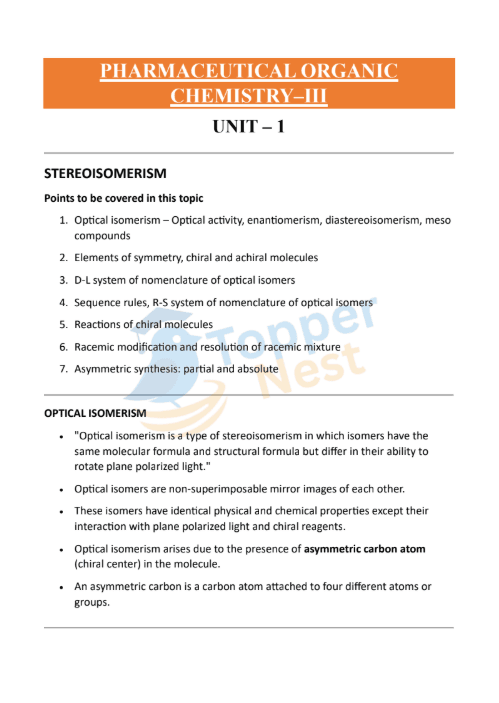
Understanding Stereoisomerism
What Is Stereoisomerism?
Stereoisomers are compounds that have:
- The same molecular formula
- The same bonding sequence
- Different spatial arrangement of atoms
Because biological systems are highly selective, even slight spatial differences can drastically change drug action.
Types of Stereoisomerism
- Optical isomerism
- Geometrical isomerism
This unit mainly focuses on optical isomerism.
Optical Isomerism Explained
Optical Activity
Optical activity is the ability of certain compounds to rotate plane-polarized light.
- Clockwise rotation → dextrorotatory (+)
- Anticlockwise rotation → levorotatory (–)
This property arises from molecular asymmetry.
Enantiomerism
Enantiomers are non-superimposable mirror images of each other, much like left and right hands.
Characteristics
- Same physical properties
- Opposite optical rotation
- Different biological effects
Many drugs exist as enantiomeric pairs, but often only one form is therapeutically active.
Diastereoisomerism
Diastereoisomers are stereoisomers that are not mirror images of each other.
Key Features
- Different physical properties
- Different melting and boiling points
- Easier to separate than enantiomers
They commonly occur in compounds with two or more chiral centers.
Meso Compounds
Meso compounds contain chiral centers but are optically inactive due to internal symmetry.
The internal mirror plane cancels optical rotation, making the molecule achiral overall.
Chirality and Symmetry
Elements of Symmetry
A molecule is achiral if it contains:
- Plane of symmetry
- Center of symmetry
- Axis of symmetry
Absence of these elements generally indicates chirality.
Chiral vs Achiral Molecules
- Chiral → optically active
- Achiral → optically inactive
Recognizing symmetry helps predict optical behavior.
Nomenclature of Optical Isomers
D–L System
The D–L system compares the molecule’s configuration with glyceraldehyde.
- D → similar to D-glyceraldehyde
- L → similar to L-glyceraldehyde
Commonly used in sugars and amino acids.
R–S System (Cahn–Ingold–Prelog Rules)
This modern system assigns configuration based on atomic priority.
Steps
- Assign priority by atomic number
- Arrange lowest priority at back
- Clockwise → R
- Anticlockwise → S
This method is more universal and widely used in modern chemistry.
Reactions of Chiral Molecules
Chiral molecules behave differently in chemical reactions.
Typical Reactions
- Retention of configuration
- Inversion of configuration
- Racemization
Reaction conditions determine stereochemical outcomes.
Understanding this is crucial in drug synthesis.
Racemic Modification and Resolution
Racemic Mixture
A racemic mixture contains equal amounts of two enantiomers and shows no optical activity.
Why Resolution Is Needed
Since enantiomers may differ biologically, separation becomes necessary.
Resolution Methods
- Mechanical separation
- Chemical resolution
- Enzymatic resolution
- Chromatography
These techniques isolate the therapeutically active form.
Asymmetric Synthesis
What Is Asymmetric Synthesis?
Asymmetric synthesis produces one enantiomer preferentially, avoiding racemic mixtures.
Types
Partial Asymmetric Synthesis
Produces excess of one isomer but not completely pure.
Absolute Asymmetric Synthesis
Produces only one enantiomer exclusively.
Importance in Pharmaceuticals
- Reduces side effects
- Improves drug efficacy
- Saves purification costs
Modern drug industries strongly prefer asymmetric synthesis.
Real-World Importance of Optical Isomerism
Stereochemistry directly affects:
- Drug potency
- Toxicity
- Metabolism
- Therapeutic safety
Many modern medicines are marketed as single-enantiomer drugs to ensure better outcomes.