
In modern organic and pharmaceutical chemistry, structure is more than just a formula—it is a three-dimensional story. Two molecules with the same atoms may behave differently simply because their groups are arranged differently in space. UNIT 2 dives into geometrical and conformational isomerism, helping students understand how molecular orientation influences stability, reactivity, and biological action.
From double-bond restrictions to flexible ring systems, stereochemistry once again proves that “shape matters.”
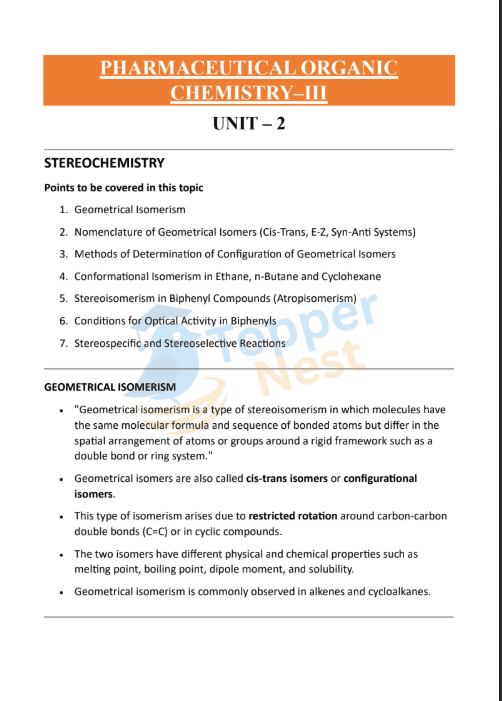
Geometrical Isomerism: Locked by Double Bonds
What Is Geometrical Isomerism?
Geometrical isomerism occurs when rotation around a double bond or ring is restricted. As a result, substituents occupy fixed positions, producing different spatial arrangements.
Basic Requirements
- Presence of a double bond or cyclic structure
- Different groups attached to each carbon
This restriction leads to distinct isomers with unique properties.
Cis–Trans Nomenclature
Cis Form
Similar groups lie on the same side of the double bond.
Trans Form
Similar groups lie on opposite sides.
Key Characteristics
- Different melting points
- Different boiling points
- Different stability
For example, trans isomers are often more stable due to less steric crowding.
E–Z System of Nomenclature
The cis–trans system is limited when all substituents differ. The E–Z system, based on priority rules, offers a more universal method.
Steps
- Assign priority using atomic number
- High priorities on same side → Z
- High priorities on opposite side → E
This system provides precise stereochemical description.
Syn–Anti System
Used mainly for oximes and related compounds.
- Syn → similar groups on same side
- Anti → opposite sides
This classification is useful for certain functional groups where cis–trans is insufficient.
Determination of Configuration
How Do Chemists Identify Geometrical Isomers?
Several methods are used to determine configuration.
Common Techniques
- Chemical methods (addition reactions)
- Physical properties comparison
- Spectroscopic methods (NMR, IR)
- X-ray crystallography
These tools help confirm spatial arrangements accurately.
Conformational Isomerism: Rotation in Action
Unlike geometrical isomers, conformational isomers arise from free rotation around single bonds. These forms interconvert rapidly but differ in energy.
Conformation of Ethane
Ethane rotates freely around the C–C bond.
Two Major Forms
- Staggered (most stable)
- Eclipsed (least stable)
Staggered conformation minimizes repulsion.
Conformation of n-Butane
More complex due to larger groups.
Important Forms
- Anti (most stable)
- Gauche
- Eclipsed
Anti form reduces steric hindrance between methyl groups.
Conformation of Cyclohexane
Cyclohexane adopts non-planar shapes to reduce strain.
Major Conformations
- Chair (most stable)
- Boat
- Twist boat
Chair form minimizes angle and torsional strain, making it highly stable.
Atropisomerism in Biphenyl Compounds
What Is Atropisomerism?
Atropisomerism occurs when rotation around a single bond is restricted due to bulky groups, creating isolable stereoisomers.
In biphenyl compounds, steric hindrance prevents free rotation, leading to optical activity.
Conditions for Optical Activity
- Bulky substituents
- Restricted rotation
- Absence of symmetry
Such compounds behave like chiral molecules even without chiral centers.
Stereospecific and Stereoselective Reactions
Stereospecific Reactions
A specific stereoisomer gives a specific product.
Example: SN2 reactions causing inversion of configuration.
Stereoselective Reactions
Multiple products form, but one is favored.
Example: Preferential formation of one alkene isomer.
Importance
- Determines product purity
- Affects biological activity
- Reduces side effects
- Improves synthetic efficiency
Modern drug synthesis relies heavily on stereoselective control.
Why These Concepts Matter in Real Life
Geometrical and conformational differences influence:
- Drug absorption
- Receptor binding
- Stability
- Toxicity
Understanding these differences helps chemists design safer and more effective medicines.