
Starting your professional course journey? One of the most essential subjects you’ll encounter in your second year is Medicinal Chemistry – I. This subject builds your foundation in understanding the chemical basis of drugs, their structures, mechanisms of action, and structure–activity relationships.
It focuses on how the chemical structure of a compound influences its biological activity, therapeutic effect, safety, and stability. This subject is vital for developing a strong understanding of drug design, synthesis, and rational use of medicines among future pharmacists and pharmaceutical professionals.
Our Medicinal Chemistry – I Notes are carefully prepared to make your study experience simple, well-structured, and exam-focused. Whether you need clear explanations of drug classification, mechanisms, SAR, or synthesis of important medicinal compounds, these notes are designed to help you grasp the concepts thoroughly and retain them effectively.
These notes will not only support your classroom learning but also serve as a quick reference guide before exams. With chemical structures, reaction pathways, key points, SAR tables, and practical examples, Medicinal Chemistry – I Notes make your preparation easier, more efficient, and exam-ready.
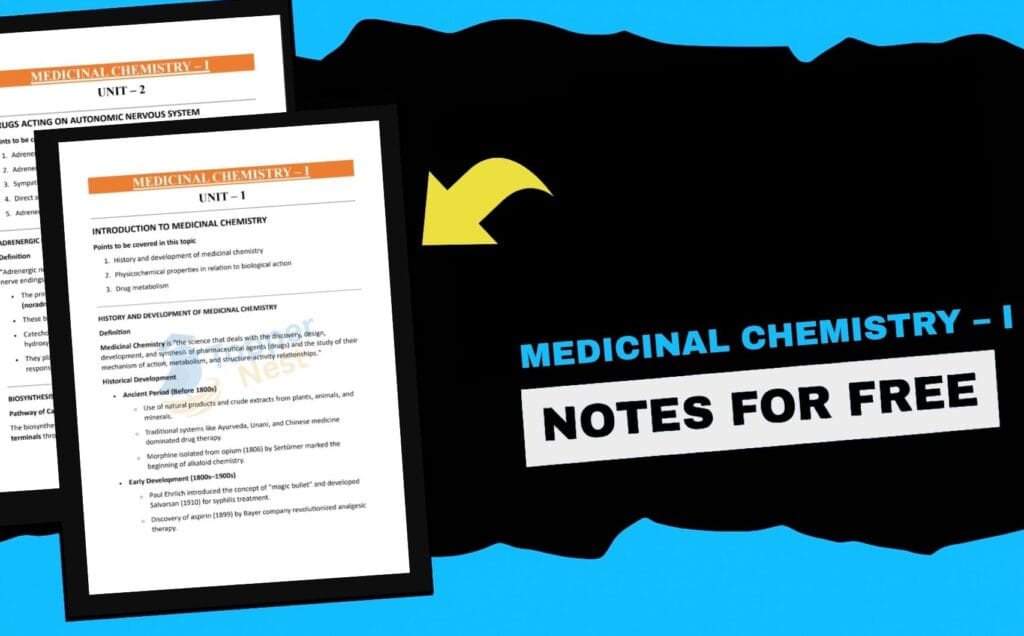
Unit-wise Notes for Medicinal chemistry – I
Medicinal Chemistry – I Notes
What is Medicinal Chemistry – I in Pharmacy?
Medicinal Chemistry – I is the branch of pharmaceutical science that deals with the design, chemical structure, synthesis, and biological activity of drugs used for therapeutic purposes.
This subject equips future pharmacists with the knowledge needed to:
- Understand how drugs act at the molecular level
- Relate chemical structure to pharmacological activity
- Study mechanisms of drug action
- Analyze drug metabolism and toxicity
- Support drug discovery and development
It forms the bridge between organic chemistry and pharmacology.
Here are the key reasons why this subject is crucial:
1. Enhancing Drug Safety and Effectiveness
Medicinal chemistry helps ensure that medicines are both effective and safe.
Structure–Activity Relationship (SAR):
Small structural changes can increase or decrease drug potency and safety.
Mechanism of Action:
Understanding how drugs interact with receptors or enzymes improves therapeutic outcomes.
Functional Groups:
Specific functional groups influence solubility, stability, and bioavailability.
Toxicity Prediction:
Chemical knowledge helps identify potentially harmful groups in drug molecules.
2. Streamlining Drug Discovery and Development
Medicinal chemistry is the backbone of modern pharmaceutical research.
Drug Design:
Rational design of molecules based on biological targets improves success rates.
Lead Optimization:
Chemical modification enhances activity and reduces side effects.
Synthesis of Drugs:
Step-by-step preparation of medicinal compounds supports large-scale production.
Prodrug Approach:
Chemical modification improves absorption and reduces toxicity.
3. Improving Professional Efficiency and Compliance
Knowledge of medicinal chemistry improves pharmacy practice and industrial roles.
Quality Control:
Identification of impurities and degradation products ensures safety.
Formulation Support:
Understanding compatibility prevents instability.
Drug Storage:
Chemical stability determines shelf life.
Regulatory Compliance:
Medicines must meet pharmacopeial and chemical standards.
Why Medicinal Chemistry – I is Important in B. Pharmacy
Medicinal Chemistry – I is important in B. Pharmacy because it connects chemical science with therapeutic action, ensuring pharmacists understand how medicines work, how they are designed, and how they should be used safely.
1. Understanding Drug Action and Patient Safety
This subject teaches how drugs produce their effects in the body.
Drug–Receptor Binding:
Determines potency and selectivity.
Metabolism:
Chemical reactions in the liver affect duration of action.
Side Effects:
Structural features may cause adverse reactions.
Rational Drug Use:
Helps pharmacists select appropriate therapy.
2. Drug Stability and Compatibility
Pharmacists must ensure medicines remain effective throughout their shelf life.
Degradation Reactions:
Hydrolysis, oxidation, and photolysis reduce potency.
Storage Conditions:
Temperature and light affect stability.
Incompatibilities:
Prevents chemical reactions between drugs and excipients.
Shelf-life Determination:
Ensures product effectiveness until expiry.
3. Research and Regulatory Compliance
Knowledge of medicinal chemistry is essential for professional and industrial practice.
Pharmacists working in research, manufacturing, or regulatory sectors must ensure that synthesis, testing, and quality control of drugs comply with chemical safety standards and regulatory guidelines to deliver safe and effective medicines to the public.