
Starting your professional course journey? One of the most essential subjects you’ll encounter in your second year is Physical Pharmaceutics – II. This subject builds your foundation in understanding the physical and biopharmaceutical principles that control drug absorption, stability, and performance of dosage forms.
It focuses on dissolution, diffusion, drug release kinetics, suspensions, emulsions, micromeritics, and stability studies. These concepts are vital for designing safe, effective, and stable pharmaceutical formulations.
Our Physical Pharmaceutics – II Notes are carefully prepared to make your study experience simple, well-structured, and exam-focused. Whether you need clear explanations of dissolution testing, complexation, interfacial phenomena, dispersed systems, or drug stability, these notes are designed to help you grasp the concepts thoroughly and retain them effectively.
These notes will not only support your classroom learning but also serve as a quick reference guide before exams. With informative diagrams, formulas, step-by-step derivations, key terms, and practical examples, Physical Pharmaceutics – II Notes make your preparation easier, more efficient, and exam-ready.
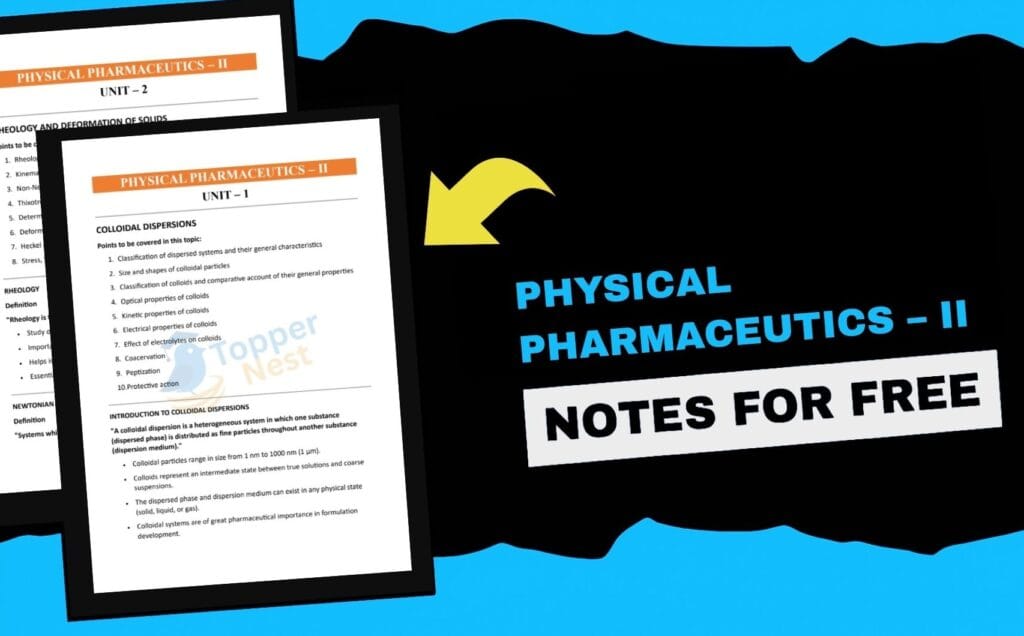
Physical Pharmaceutics – II Notes
What is Physical Pharmaceutics – II in Pharmacy?
Physical Pharmaceutics – II is the branch of pharmaceutics that applies physical chemistry and biopharmaceutical principles to understand how drugs dissolve, diffuse, release, and reach the site of action.
This subject equips future pharmacists with the knowledge needed to:
- Study drug absorption and bioavailability
- Design stable dispersed systems
- Understand drug release mechanisms
- Evaluate formulation performance
- Improve therapeutic effectiveness
It connects theoretical science with practical formulation development.
Here are the key reasons why this subject is crucial:
1. Enhancing Drug Absorption and Bioavailability
Drug performance largely depends on its dissolution and diffusion behavior.
Dissolution Rate:
Drugs must dissolve before absorption. Faster dissolution improves therapeutic effect.
Diffusion Principles:
Drug movement across membranes follows Fick’s law.
Drug Release Kinetics:
Helps predict how quickly a drug acts in the body.
Bioavailability Studies:
Evaluate how much drug reaches systemic circulation.
2. Supporting Formulation and Dosage Form Development
This subject is essential for designing liquid and dispersed dosage forms.
Suspensions:
Knowledge of sedimentation and flocculation improves stability.
Emulsions:
Understanding interfacial tension helps maintain uniformity.
Complexation:
Improves solubility and stability of drugs.
Colloidal Systems:
Important in creams, gels, and nanoformulations.
3. Improving Professional Efficiency and Quality Control
Physical pharmaceutics helps maintain quality standards in pharmaceutical practice.
Stability Testing:
Determines shelf life of formulations.
Particle Size Analysis:
Affects dissolution rate and bioavailability.
Rheological Evaluation:
Ensures proper flow and consistency.
Regulatory Compliance:
Products must meet pharmacopeial specifications.
Why Physical Pharmaceutics – II is Important in B. Pharmacy
Physical Pharmaceutics – II is important in B. Pharmacy because it connects drug formulation with therapeutic performance, ensuring medicines are safe, stable, and effective throughout their shelf life.
1. Understanding Drug Performance in the Body
This subject teaches future pharmacists how physical factors influence treatment outcomes.
Drug Absorption:
Controlled by dissolution and membrane permeability.
Controlled Release Systems:
Helps maintain steady drug levels.
Pharmacokinetics:
Explains onset, duration, and intensity of action.
Dose Optimization:
Improves patient compliance and safety.
2. Stability and Compatibility of Formulations
Pharmacists must ensure medicines remain effective until expiry.
Sedimentation Control:
Prevents separation in suspensions.
Emulsion Stability:
Prevents creaming and cracking.
Degradation Prevention:
Protects drugs from heat, light, and moisture.
Proper Storage:
Maintains formulation integrity.
3. Regulatory Compliance
Knowledge of physical and biopharmaceutical principles is necessary for professional practice.
Pharmacists working in manufacturing, research, or quality assurance must ensure that formulation development, testing, and storage comply with pharmacopeial standards and regulatory guidelines to deliver high-quality medicines safely to patients.