
Every time a patient swallows a tablet or receives an injection, a complex scientific journey begins inside the body. How the drug acts, how fast it works, how long it lasts, and how it leaves the body are all explained by general pharmacology. This foundational subject connects chemistry, physiology, and therapeutics.
UNIT 1 introduces the basic principles of drug action and pharmacokinetics, helping students understand how medicines interact with the human body from administration to elimination.
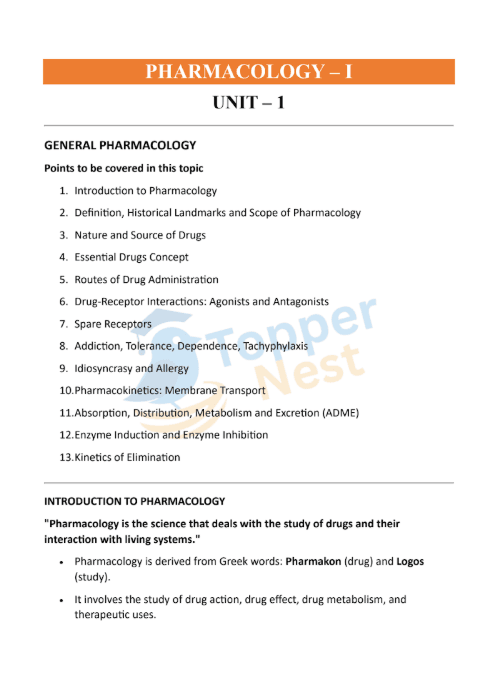
Introduction to Pharmacology
Definition and Scope
Pharmacology is the science that studies drugs and their effects on living systems. It explains how drugs prevent, diagnose, and treat diseases.
Scope Includes
- Drug discovery
- Mechanism of action
- Therapeutic uses
- Toxic effects
- Clinical applications
Modern pharmacology plays a key role in public health and drug development.
Historical Landmarks
Pharmacology evolved from herbal remedies to modern synthetic drugs. Early milestones include discoveries of anesthesia, antibiotics, and receptor theory. These breakthroughs shaped contemporary medicine.
Nature and Source of Drugs
Drugs originate from multiple sources.
Major Sources
- Plants (morphine, quinine)
- Animals (insulin, hormones)
- Minerals (iron, iodine)
- Synthetic chemicals
- Biotechnology products
This diversity allows tailored treatments for various diseases.
Essential Drugs Concept
The essential drugs concept ensures availability of safe, effective, and affordable medicines to the population.
Objectives
- Accessibility
- Rational use
- Cost-effectiveness
- Public health improvement
This approach guides healthcare policy worldwide.
Routes of Drug Administration
The route affects speed and extent of drug action.
Common Routes
- Oral
- Intravenous
- Intramuscular
- Subcutaneous
- Topical
- Inhalation
Choice depends on drug properties and clinical needs.
Drug–Receptor Interactions
Agonists
Agonists bind receptors and produce a biological response.
Antagonists
Antagonists bind receptors but block action.
Types
- Competitive antagonists (reversible)
- Non-competitive antagonists (irreversible)
These interactions determine therapeutic outcomes.
Spare Receptors
Spare receptors allow maximum response even when all receptors are not occupied. This increases drug sensitivity.
Drug Response Phenomena
Understanding unusual responses is essential in clinical practice.
Key Terms
- Addiction – psychological dependence
- Tolerance – reduced response with repeated use
- Dependence – withdrawal symptoms on stopping
- Tachyphylaxis – rapid tolerance
- Idiosyncrasy – abnormal reaction
- Allergy – immune-mediated response
These effects influence safe drug therapy.
Pharmacokinetics: What the Body Does to the Drug
Pharmacokinetics describes the movement of drugs in the body through ADME.
Membrane Transport
Drugs cross membranes by:
- Passive diffusion
- Active transport
- Facilitated diffusion
- Endocytosis
Lipid-soluble drugs cross easily, while polar drugs need carriers.
Absorption
Absorption is the process by which drugs enter bloodstream.
Factors Affecting Absorption
- Solubility
- Surface area
- Blood flow
- pH
Proper absorption ensures therapeutic levels.
Distribution
After absorption, drugs distribute to tissues.
Influenced By
- Blood flow
- Plasma protein binding
- Tissue permeability
Highly bound drugs have longer action.
Metabolism
Drug metabolism mainly occurs in the liver.
Functions
- Convert lipid-soluble drugs into water-soluble forms
- Facilitate excretion
Enzyme Induction
Increases metabolism, reducing drug effect.
Enzyme Inhibition
Decreases metabolism, increasing toxicity risk.
Both significantly affect dosing.
Excretion
Drugs are eliminated via:
- Kidneys (urine)
- Bile
- Sweat
- Lungs
Efficient elimination prevents accumulation.
Kinetics of Elimination
First-Order Kinetics
Constant fraction eliminated per unit time.
Zero-Order Kinetics
Constant amount eliminated.
Understanding elimination kinetics helps determine dosing intervals.
Why General Pharmacology Matters
Knowledge of pharmacology ensures:
- Safe drug use
- Effective therapy
- Reduced side effects
- Rational prescribing
It forms the foundation for advanced clinical pharmacy.