
In modern pharmaceutical research, drug solubility is often the deciding factor between a successful medicine and a failed formulation. A compound may show excellent therapeutic action in the laboratory, but without adequate solubility, it cannot dissolve, diffuse, or reach its biological target. UNIT 1 focuses on the science behind solubility, diffusion, and distribution—concepts that form the backbone of drug delivery and bioavailability studies.
From tablets dissolving in the stomach to gases diffusing through the lungs, solubility principles quietly govern how medicines work inside the body.
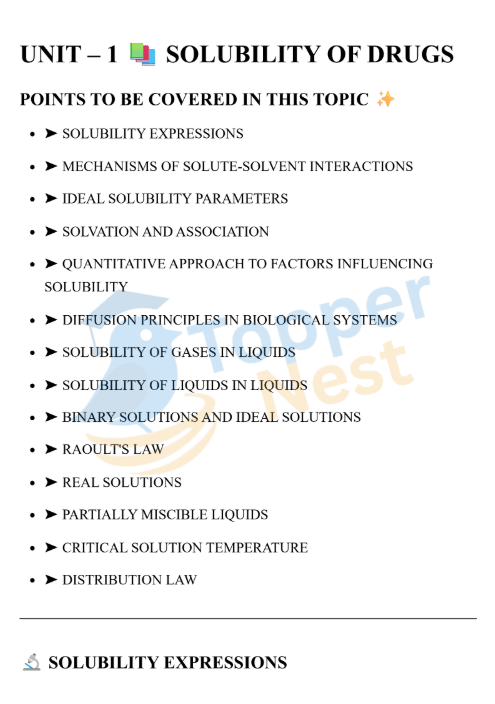
Understanding Solubility of Drugs
What Is Solubility?
Solubility is defined as the maximum amount of solute that dissolves in a given quantity of solvent at a specified temperature and pressure, forming a stable solution. In pharmacy, solubility determines how quickly and completely a drug becomes available for absorption.
Solubility Expressions
Drug solubility can be expressed in several ways:
- Parts of solute per parts of solvent
- Percentage strength
- Molarity or molality
- Mole fraction
These expressions help chemists quantify and compare drug dissolution accurately.
Mechanisms of Solute–Solvent Interactions
How Dissolution Occurs
Dissolution involves breaking solute–solute interactions and forming new solute–solvent interactions. The process depends largely on intermolecular forces.
Types of Interactions
- Hydrogen bonding
- Dipole–dipole attraction
- Ion–dipole interaction
- Van der Waals forces
The rule “like dissolves like” summarizes that polar solutes dissolve best in polar solvents, while nonpolar solutes dissolve in nonpolar solvents.
Ideal Solubility Parameters and Molecular Behavior
Ideal Solubility
Ideal solubility assumes no strong specific interactions and depends only on temperature and melting point. It provides a theoretical reference for predicting solubility behavior.
Solvation and Association
- Solvation occurs when solvent molecules surround solute particles, stabilizing them.
- Association happens when solute molecules aggregate, reducing effective solubility.
In drug formulations, excessive association can lead to precipitation or poor bioavailability.
Quantitative Factors Influencing Drug Solubility
Pharmaceutical scientists use quantitative methods to analyze how various factors affect solubility.
Major Factors Include:
- Temperature
- Particle size
- Nature of solvent
- pH of the medium
- Pressure (for gases)
For example, weakly acidic drugs dissolve better in alkaline media due to ionization, enhancing absorption.
Diffusion Principles in Biological Systems
What Is Diffusion?
Diffusion is the movement of molecules from higher concentration to lower concentration. In the human body, drug molecules must diffuse across biological membranes to produce therapeutic action.
Fick’s Law of Diffusion
According to Fick’s law, the rate of diffusion depends on:
- Concentration gradient
- Surface area
- Membrane thickness
- Diffusion coefficient
These principles explain how quickly drugs are absorbed through the stomach lining, skin, or lungs.
Solubility of Gases in Liquids
Henry’s Law Explained
The solubility of a gas in a liquid is directly proportional to its partial pressure above the liquid. This relationship is described by Henry’s law.
Pharmaceutical and Biological Importance
- Oxygen dissolving in blood
- Carbon dioxide exchange in respiration
- Carbonated medicinal preparations
Higher pressure increases gas solubility, while increased temperature reduces it.
Solubility of Liquids in Liquids: Binary and Ideal Solutions
Binary Solutions
Binary solutions consist of two liquids that mix together. Their behavior may be ideal or non-ideal depending on molecular interactions.
Ideal Solutions and Raoult’s Law
In ideal solutions, each component obeys Raoult’s law, which states that the vapor pressure of a component is proportional to its mole fraction.
Key features include:
- No heat change on mixing
- No volume change
- Similar intermolecular forces
These systems are useful for theoretical modeling.
Real Solutions and Deviations
Most pharmaceutical solutions are real, not ideal.
Deviations Occur When:
- Solute–solvent interactions are stronger
- Interactions are weaker
- Molecular sizes differ significantly
These deviations affect vapor pressure and solubility behavior, influencing formulation stability.
Partially Miscible Liquids and Critical Solution Temperature
Partially Miscible Liquids
Some liquids dissolve only to a limited extent, forming two layers at certain compositions.
Critical Solution Temperature (CST)
CST is the temperature above or below which liquids become completely miscible.
Applications
- Drug extraction
- Purification processes
- Solvent selection in formulation
Understanding CST helps optimize pharmaceutical manufacturing.
Distribution Law: Drug Partitioning Between Phases
What Is Distribution Law?
The distribution law states that when a solute is added to two immiscible solvents, it distributes itself between them in a constant ratio at equilibrium.
Mathematical Expression
The ratio of concentrations remains constant, known as the partition coefficient.
Applications in Pharmacy
- Drug extraction techniques
- Determination of lipid solubility
- Prediction of membrane permeability
- Design of sustained-release formulations
Limitations
- Not valid for ionized solutes
- Association or dissociation affects results
- Temperature dependency