
Every tablet, capsule, or injection begins with one essential question: how will this molecule behave inside the human body? Medicinal chemistry answers that question by combining organic chemistry, biology, and pharmacology to design safer and more effective drugs.
From early dye-based therapies to modern targeted medicines, the science of medicinal chemistry has evolved rapidly. UNIT 1 lays the foundation by exploring how drug structure, physicochemical properties, and metabolism determine therapeutic action.
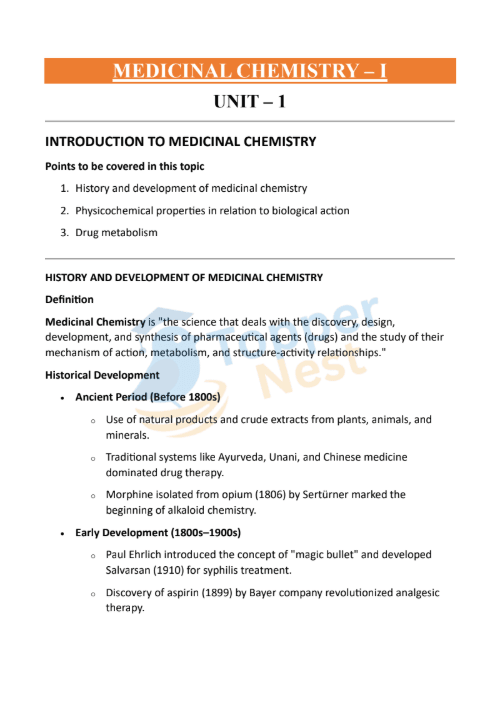
History and Development of Medicinal Chemistry
The story of medicinal chemistry began with Paul Ehrlich, who introduced the concept of the “magic bullet”—a compound that selectively targets disease-causing organisms. His work on arsenic-based drugs marked the birth of rational drug design.
Later developments included:
- Antibiotic discovery
- Synthetic drug development
- Structure–activity relationship (SAR) studies
- Computer-aided drug design
Today, medicinal chemistry is central to vaccine development, anticancer therapy, and precision medicine.
Physicochemical Properties in Relation to Biological Action
A drug’s success depends largely on its physicochemical properties. These characteristics control absorption, distribution, metabolism, and elimination (ADME).
Ionization
Most drugs are weak acids or bases. Their ionization depends on pH.
- Unionized form → better membrane permeability
- Ionized form → better water solubility
Correct ionization ensures effective absorption across biological membranes.
Solubility
Drugs must dissolve before absorption.
Types
- Aqueous solubility
- Lipid solubility
Poor solubility leads to reduced bioavailability, making formulation challenging.
Partition Coefficient
The partition coefficient measures a drug’s distribution between oil and water phases.
Significance
- High lipid solubility → better membrane penetration
- Excess lipophilicity → poor excretion
Balanced partitioning ensures optimal therapeutic effect.
Hydrogen Bonding
Hydrogen bonding affects:
- Drug–receptor interactions
- Solubility
- Stability
Proper hydrogen bonding increases binding specificity and potency.
Protein Binding
Drugs often bind to plasma proteins like albumin.
Effects
- Reduces free drug concentration
- Prolongs duration of action
- May cause drug–drug interactions
Only the unbound fraction is pharmacologically active.
Chelation
Some drugs form complexes with metal ions.
Examples
- Tetracyclines with calcium
- Chelating agents in heavy metal poisoning
Chelation can either reduce absorption or enhance therapeutic action.
Bioisosterism
Bioisosterism involves replacing one functional group with another having similar properties to improve activity or reduce toxicity.
Benefits
- Increased potency
- Better stability
- Reduced side effects
It is widely used in modern drug optimization.
Optical and Geometrical Isomerism
Stereochemistry strongly influences biological action.
- One isomer may be active
- The other may be inactive or toxic
Thus, stereochemical purity is crucial in drug development.
Drug Metabolism: How the Body Handles Drugs
Once inside the body, drugs undergo metabolic changes mainly in the liver. These reactions make drugs more water-soluble for elimination.
Principles of Drug Metabolism
Drug metabolism aims to:
- Detoxify foreign substances
- Increase solubility
- Facilitate excretion
Metabolism may activate, inactivate, or sometimes produce toxic metabolites.
Phase I Reactions (Functionalization)
Phase I introduces or exposes functional groups.
Common Processes
- Oxidation
- Reduction
- Hydrolysis
These reactions slightly modify drug structure.
Phase II Reactions (Conjugation)
Phase II attaches polar groups to metabolites.
Examples
- Glucuronidation
- Sulfation
- Acetylation
- Methylation
These reactions greatly increase water solubility and promote excretion.
Factors Affecting Drug Metabolism
Several variables influence metabolic rate:
- Age
- Genetics
- Diet
- Disease state
- Drug interactions
- Enzyme induction or inhibition
Stereochemical Aspects
Different stereoisomers may be metabolized differently.
One enantiomer may clear faster, while the other remains longer, affecting efficacy and toxicity. Hence, stereochemistry plays a key role in pharmacokinetics.
Why Medicinal Chemistry Matters Today
Medicinal chemistry helps scientists:
- Design safer drugs
- Reduce toxicity
- Improve bioavailability
- Optimize metabolism
- Enhance therapeutic action
Without understanding physicochemical and metabolic principles, effective drug design would be impossible.