
Behind every tablet, inhaler, or injectable drug lies a careful understanding of states of matter and physicochemical properties. Before a medicine reaches patients, scientists must know how it melts, dissolves, vaporizes, or interacts with solvents. These physical and molecular properties directly affect stability, solubility, absorption, and therapeutic performance.
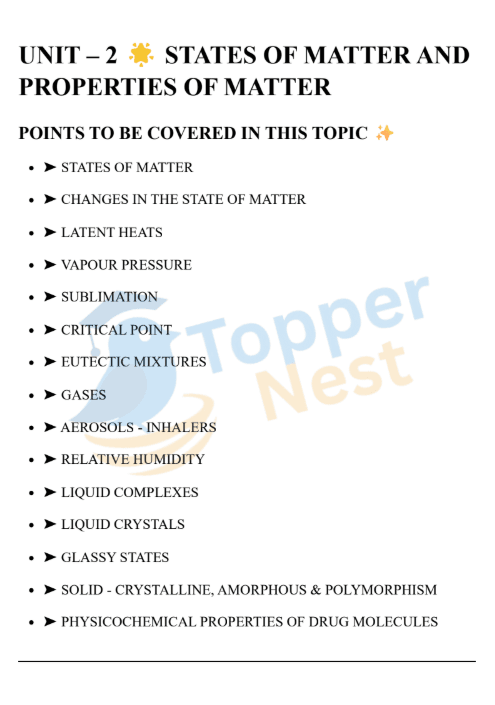
States of Matter: The Foundation of Pharmaceutical Materials
What Is a State of Matter?
Matter exists mainly as:
- Solids
- Liquids
- Gases
Each state differs in particle arrangement and energy. Solids are tightly packed, liquids flow with moderate freedom, and gases expand freely. Drug substances may appear in any of these forms depending on formulation needs.
Changes in the State of Matter and Latent Heats
Phase Transitions
Temperature and pressure changes cause matter to shift between states.
- Melting
- Freezing
- Vaporization
- Condensation
- Sublimation
These transitions are essential in processes like drying, sterilization, and drug crystallization.
Latent Heat
Latent heat is the energy absorbed or released without a change in temperature during phase change. Knowledge of latent heat helps control manufacturing steps such as freeze-drying and melting of excipients.
Vapour Pressure, Sublimation, and Critical Point
Vapour Pressure
Vapour pressure measures how easily molecules escape from a liquid or solid into the vapor phase. High vapour pressure indicates rapid evaporation.
Importance in pharmacy:
- Drug stability
- Packaging decisions
- Storage requirements
Sublimation
Certain solids convert directly into vapor. This process is used in lyophilization, preserving heat-sensitive drugs.
Critical Point
At the critical point, liquid and gas phases become indistinguishable. Supercritical fluids formed at this stage are used for extraction and purification of drugs.
Eutectic Mixtures and Gas Systems
Eutectic Mixtures
A eutectic mixture melts at a lower temperature than individual components. Some drug powders form eutectics, leading to unexpected liquefaction.
Understanding this helps avoid formulation instability.
Gases and Pharmaceutical Aerosols
Aerosols disperse fine particles in a gas and are widely used in inhalers.
Benefits include:
- Fast therapeutic action
- Targeted lung delivery
- Reduced systemic effects
- Patient convenience
They are critical in asthma and respiratory treatments.
Relative Humidity, Liquid Complexes, and Liquid Crystals
Relative Humidity
Relative humidity indicates moisture content in air. Excess moisture can degrade tablets, promote hydrolysis, and reduce shelf life. Controlled storage is therefore essential.
Liquid Complexes
Liquid complexes form when liquids interact through weak forces. These systems enhance drug solubility and stability.
Liquid Crystals
Liquid crystals show properties between solids and liquids. They are increasingly used in controlled-release and transdermal drug delivery systems.
Solid Forms: Crystalline, Amorphous, Glassy, and Polymorphism
Crystalline Solids
- Regular structure
- Sharp melting point
- High stability
Amorphous Solids
- Irregular arrangement
- Higher solubility
- Faster dissolution
Glassy State
A rigid, non-crystalline form produced by rapid cooling. It often improves bioavailability.
Polymorphism
Polymorphism occurs when one drug exists in multiple crystalline forms. Each form may differ in solubility, melting point, and absorption rate. Selecting the correct polymorph is crucial for effective therapy.
Physicochemical Properties of Drug Molecules
Understanding molecular properties helps predict how drugs behave in solution and in the body.
Refractive Index
Refractive index measures how light bends when passing through a substance.
Applications
- Purity testing
- Concentration determination
- Identification of liquids
It is commonly measured using refractometers.
Optical Rotation
Optical rotation occurs when chiral molecules rotate plane-polarized light.
Importance
- Identifies enantiomers
- Determines drug purity
- Essential for stereospecific drugs
Measured using a polarimeter, this property is critical since many drugs show activity only in one optical form.
Dielectric Constant
The dielectric constant measures a solvent’s ability to reduce electrostatic forces between ions.
Significance
- Predicts solubility of ionic drugs
- Guides solvent selection
- Influences dissociation and stability
Water’s high dielectric constant makes it an excellent solvent for many drugs.
Dipole Moment
Dipole moment indicates molecular polarity.
Why It Matters
- Predicts intermolecular interactions
- Helps estimate solubility
- Influences membrane permeability
More polar molecules generally dissolve better in polar solvents.
Dissociation Constant
The dissociation constant (Ka or pKa) measures the extent of ionization of weak acids or bases.
Applications
- Predicts drug solubility at different pH
- Determines absorption rate
- Guides buffer preparation
- Influences bioavailability
It is commonly determined by titration or pH-metric methods.