
In pharmaceutical science, some of the most important reactions occur not in the bulk of a solution, but at surfaces and interfaces. From emulsions in syrups to creams, suspensions, and detergents, the behavior of molecules at boundaries determines stability, solubility, and effectiveness. UNIT 3 introduces the science of surface and interfacial phenomena, a key topic connecting physical chemistry with real-world drug formulation.
Whether designing an emulsion, improving solubility of poorly water-soluble drugs, or creating stable suspensions, understanding surface chemistry is essential.
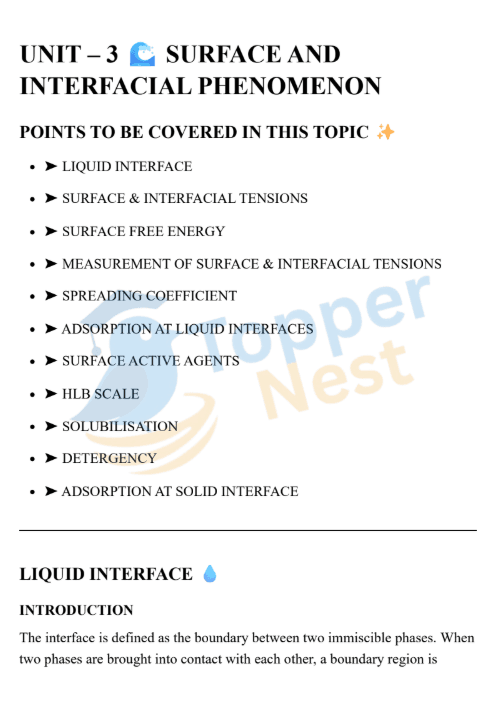
Liquid Interfaces: Where Phases Meet
What Is an Interface?
An interface is the boundary separating two immiscible phases, such as:
- Liquid–gas (water–air)
- Liquid–liquid (oil–water)
- Solid–liquid (tablet–solution)
At these boundaries, molecules experience unequal forces, giving rise to unique physical properties.
Why Interfaces Matter in Pharmacy
Interfaces influence:
- Emulsion stability
- Drug dissolution
- Wetting of powders
- Absorption across membranes
Thus, surface chemistry plays a central role in drug delivery systems.
Surface and Interfacial Tension Explained
Surface Tension
Surface tension is the force acting along the surface of a liquid that tends to minimize its area. It arises because surface molecules experience inward cohesive forces.
Water, for example, has high surface tension due to hydrogen bonding.
Interfacial Tension
Interfacial tension exists between two immiscible liquids like oil and water. Lower interfacial tension allows easier mixing or emulsification.
Pharmaceutical Importance
High tension can hinder drug wetting, while low tension improves spreading and dissolution.
Surface Free Energy and Its Significance
Surface free energy is the excess energy present at the surface compared to the bulk phase. Systems naturally try to reduce this energy by minimizing surface area or by adding surfactants.
Lowering surface free energy improves:
- Spreading of liquids
- Stability of dispersions
- Drug solubilization
Measurement of Surface and Interfacial Tension
Common Methods Used
Scientists measure surface properties using several techniques:
- Capillary rise method
- Drop weight or drop count method
- Stalagmometer method
- Du Noüy ring method
These measurements help optimize formulations such as emulsions, suspensions, and sprays.
Spreading Coefficient: Wetting Made Simple
What Is Spreading?
Spreading occurs when one liquid spreads over another surface. The spreading coefficient determines whether spreading is favorable.
- Positive value → spreading occurs
- Negative value → no spreading
Applications
- Creams and ointments
- Topical drugs
- Coating tablets
Good spreading ensures uniform drug distribution.
Adsorption at Liquid Interfaces
Adsorption is the accumulation of molecules at a surface or interface.
Types of Adsorption
- Physical adsorption (weak forces)
- Chemical adsorption (strong bonding)
At liquid interfaces, surfactant molecules orient themselves to reduce surface tension, stabilizing emulsions and foams.
Surface Active Agents: The Game Changers
What Are Surfactants?
Surface active agents, or surfactants, reduce surface and interfacial tension. They contain:
- Hydrophilic head
- Hydrophobic tail
This dual nature allows them to interact with both water and oil.
Types of Surfactants
- Anionic
- Cationic
- Nonionic
- Zwitterionic
Each type has specific pharmaceutical applications.
HLB Scale: Selecting the Right Surfactant
What Is HLB?
The Hydrophilic–Lipophilic Balance (HLB) scale measures the balance between water-loving and oil-loving parts of a surfactant.
- Low HLB → oil soluble
- High HLB → water soluble
Uses of HLB
- Choosing emulsifiers
- Stabilizing creams and lotions
- Improving drug solubility
Correct HLB ensures stable and effective formulations.
Solubilization and Detergency
Solubilization
Solubilization occurs when surfactants form micelles that trap insoluble drugs inside their hydrophobic core, increasing apparent solubility.
Benefits
- Enhances bioavailability
- Improves stability
- Enables liquid formulations
Detergency
Detergency is the cleansing action of surfactants. It involves:
- Wetting
- Emulsification
- Solubilization
- Removal of dirt
Detergents are used in cleaning pharmaceutical equipment and skin preparations.
Adsorption at Solid Interfaces
What Happens at Solid Surfaces?
Drug particles can adsorb gases, liquids, or solutes at their surfaces. This affects:
- Dissolution rate
- Stability
- Flow properties
Applications
- Activated charcoal for poisoning treatment
- Tablet formulation
- Controlled drug release
Solid adsorption plays an important role in therapeutic and industrial processes.