
In pharmaceutical manufacturing, separating solids from liquids is a daily necessity. Whether clarifying syrups, sterilizing injections, or recovering crystals, filtration and centrifugation are two essential processes that ensure product purity and quality. UNIT 4 highlights these separation techniques, showing how engineering tools quietly safeguard every medicine that reaches the patient.
From simple filter presses to high-speed centrifuges, these systems help industries achieve efficiency, sterility, and consistency.
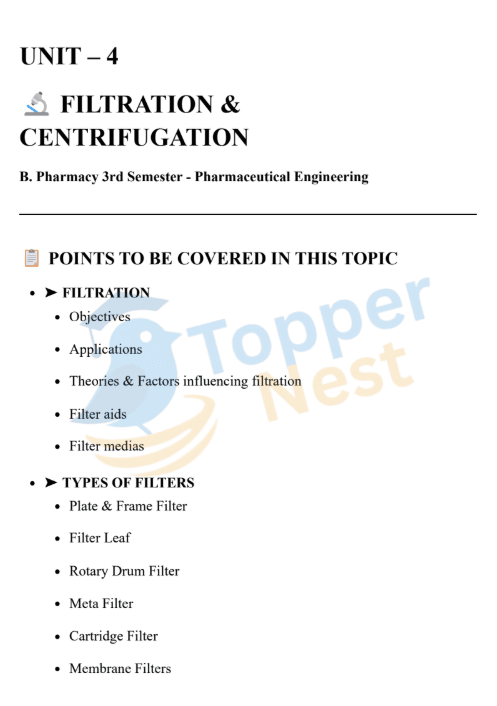
Filtration in Pharmaceutical Engineering
Objectives and Applications of Filtration
Filtration separates solid particles from liquids or gases by passing the mixture through a porous barrier.
Main Objectives
- Remove suspended impurities
- Clarify solutions
- Sterilize heat-sensitive liquids
- Recover valuable solids
Applications
Filtration is widely used in injections, syrups, antibiotic production, and water purification.
Theories of Filtration
Filtration is explained by two main mechanisms:
- Surface filtration: particles collect on the filter surface
- Depth filtration: particles are trapped within filter pores
Both mechanisms contribute to effective separation depending on filter type.
Factors Influencing Filtration
Efficiency depends on:
- Particle size
- Viscosity of liquid
- Pressure difference
- Filter area
- Temperature
Optimizing these factors increases speed and clarity of filtration.
Filter Aids and Filter Media
Filter Aids
Filter aids such as diatomaceous earth improve filtration by preventing clogging and increasing porosity.
Filter Media
Common media include:
- Filter paper
- Cloth
- Metal screens
- Membranes
Selection depends on required particle retention and sterility.
Types of Filtration Equipment
Plate and Frame Filter Press
Consists of alternating plates and frames.
Merits: Large capacity, effective
Demerits: Time-consuming cleaning
Filter Leaf
Metallic leaf coated with filter medium.
Use: Slurry filtration
Advantage: Easy cake removal
Rotary Drum Filter
Continuous rotating drum partially immersed in slurry.
Best for: Large-scale continuous operation
Meta Filter
Stack of grooved discs.
Suitable for: Viscous liquids
Compact design
Cartridge Filter
Replaceable cylindrical cartridges.
Common in: Sterile filtration
Easy maintenance
Membrane Filters
Thin synthetic membranes with precise pore size.
Application: Microbial removal and sterilization
Seidtz Filter
Depth-type asbestos pad filter for sterile preparations.
Used for removing microorganisms from heat-sensitive solutions.
Centrifugation: High-Speed Separation
Objectives and Principle of Centrifugation
Centrifugation separates particles based on density differences using centrifugal force.
When rotated rapidly, heavier particles move outward while lighter liquids remain near the center.
Applications of Centrifugation
- Separation of crystals
- Clarification of suspensions
- Blood component separation
- Recovery of precipitates
It provides faster separation than filtration in many cases.
Types of Centrifuges
Perforated Basket Centrifuge
Basket with perforations lined with filter cloth.
Uses: Crystal separation
Merits: Efficient drainage
Demerits: Batch process
Non-Perforated Basket Centrifuge
Solid bowl design.
Used for: Liquid–liquid separation
Limitation: No solid filtration
Semi-Continuous Centrifuge
Allows partial continuous discharge.
Better productivity than batch types
Super Centrifuge
High-speed machine generating very high centrifugal force.
Applications: Fine particles, emulsions, biological materials
Advantage: Excellent separation efficiency
Filtration vs Centrifugation: Quick Comparison
| Feature | Filtration | Centrifugation |
|---|---|---|
| Principle | Porous barrier | Centrifugal force |
| Speed | Moderate | Faster |
| Best for | Coarse solids | Fine particles |
| Operation | Simple | Mechanical |
Both techniques are often used together for maximum efficiency.