
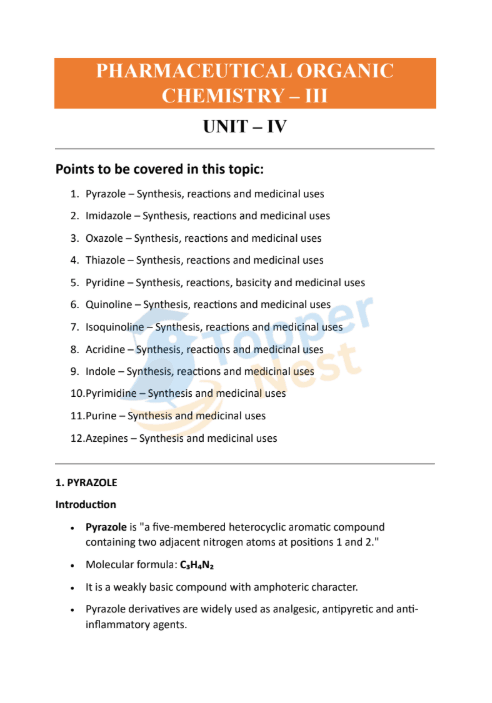
Walk into any medicinal chemistry lab and you’ll quickly notice a pattern: most drugs are built around heterocyclic rings. These small nitrogen, oxygen, or sulfur-containing structures form the backbone of antibiotics, antivirals, antihistamines, and anticancer agents. UNIT 4 explores these biologically powerful molecules, focusing on their synthesis, reactivity, and medicinal uses.
From simple five-membered rings to fused aromatic systems, heterocycles dominate modern drug design because they offer stability, polarity, and precise biological interaction.
Five-Membered Heterocycles: Small Rings, Big Impact
Pyrazole
Synthesis
- From hydrazine with 1,3-dicarbonyl compounds
- Cyclization reactions
Reactions
- Electrophilic substitution
- N-substitution
Medicinal Uses
- Anti-inflammatory drugs
- Analgesics
- Antipyretics
Imidazole
Synthesis
- Debus–Radziszewski synthesis
- Condensation of glyoxal and ammonia
Reactions
- Amphoteric behavior
- Substitution at C-4 or C-5
Medicinal Uses
- Antifungal agents
- Proton pump inhibitors
- Antihistamines
Imidazole is present in histidine and many biological molecules.
Oxazole and Thiazole
Synthesis
- Cyclization of α-halo ketones with amides or thiourea
Reactions
- Electrophilic substitution
- Nucleophilic attack
Medicinal Uses
- Vitamin B₁ (thiazole ring)
- Antibacterial and anti-inflammatory drugs
Six-Membered and Fused Heterocycles
Pyridine
Basicity of Pyridine
Unlike pyrrole, pyridine’s nitrogen lone pair does not participate in aromaticity. It remains available for protonation, making pyridine basic.
Reactions
- Nucleophilic substitution
- Salt formation
Uses
- Solvent
- Drug intermediates
Quinoline, Isoquinoline, Acridine, and Indole
Synthesis
- Skraup synthesis (quinoline)
- Bischler–Napieralski (isoquinoline)
- Fischer indole synthesis
Medicinal Uses
- Antimalarials (quinoline)
- Antiseptics (acridine)
- Tryptophan and serotonin (indole derivatives)
These fused systems show strong biological activity.
Nucleic Acid Bases and Larger Rings
Pyrimidine and Purine
Synthesis
- Condensation reactions
- Multicomponent cyclization
Medicinal Uses
- DNA/RNA bases
- Anticancer drugs
- Antiviral agents
Purine and pyrimidine form the basis of genetic material.
Azepine
Medicinal Uses
- Antipsychotics
- Antidepressants
- Anticonvulsants
Their larger ring size provides flexibility for receptor binding.
Why Heterocycles Dominate Medicinal Chemistry
Heterocycles offer:
- Improved solubility
- Enhanced binding to enzymes
- Greater metabolic stability
- Structural diversity
Over 70% of modern drugs contain at least one heterocyclic ring.